

For first-time visitors to the Hawaiian Islands, tasting local food is a central part of the trip. Yet, few dishes carry as much cultural heritage as poi. If you have sampled a small cup of purple paste at a resort buffet and wondered why locals treasure it, you are not alone. Many travelers leave Hawaii without tasting authentic, freshly prepared poi.
Real Hawaiian poi is not a uniform food. It changes in flavor, density, and character based on how farmers grow it, how cooks process it, and when you eat it. Understanding the transformation of kalo (taro) from flooded terraces to the basalt stone pōhaku (poi pounder) reveals why traditional hand-pounded poi tastes and feels completely different from commercial versions.
What Is Kalo? The Sacred Origin of Hawaiian Nutrition
To know poi, you have to know kalo (Colocasia esculenta). Native Hawaiians cultivated dozens of distinct varieties of taro across the islands. In traditional Hawaiian cosmology, kalo is Hāloanakalaukapalili, the elder brother of the Hawaiian people. This ancestral connection shapes how we treat the crop from planting to serving.
Kalo is a resilient root crop that thrives in wet, tropical environments. While we cook and eat the large leaves (lūʻau) like spinach, the starchy underground corm is the main star. Rich in complex carbohydrates, fiber, potassium, and essential vitamins, kalo provided the primary sustenance for ancient Hawaiian society.
Growing high-quality kalo requires patient work. The plant takes nine to fourteen months to mature, drawing nutrients from volcanic soil and fresh stream water flowing down mountain watersheds.
From Mountain Streams to the Loʻi: Wetland Cultivation
The journey of fresh Hawaiian poi starts in the mountains, where rain collects in streams and flows into valley watersheds. Hawaiian agricultural engineering uses irrigation systems called ʻauwai, which direct cool freshwater into terraced mud paddies known as loʻi kalo.
The Ecosystem of a Loʻi
Unlike dryland taro grown in rain-fed soil, wetland kalo requires continuous water movement. Stagnant water causes root rot, while warm water starves the root of oxygen. The steady flow of cool mountain water regulates soil temperature, prevents disease, and delivers minerals to the root system.
Working in a loʻi is demanding physical labor. Farmers wade through mud to tend the crop, weeding by hand and checking water flow daily. This close care ensures that each corm grows dense and rich in natural starch. When the leaves yellow and droop, the corm has reached peak starch concentration, signaling harvest time.
Harvesting and Preparation: Respecting the Corm
Harvesting kalo requires careful handling so the corm remains undamaged. Farmers loosen the mud by hand or with a digging stick, gently lifting the root from the earth. Once pulled, we separate the corm from its stalk (huli), which we replant immediately to start the next growth cycle.
Before cooking, the corm requires careful cleaning. We scrub the fibrous outer skin and prepare the root for steaming. Raw taro contains calcium oxalate crystals, which irritate the mouth and throat if eaten raw. Thorough steaming breaks down these crystals completely, turning tough starches into a tender, digestible food.
We steam whole corms in large pots or underground earth ovens (ʻimu) until a fork glides through the center. At this stage, warm taro gives off a rich, earthy aroma.
The Art of the Pōhaku: Hand-Pounded Paʻiʻai vs. Machine Processing
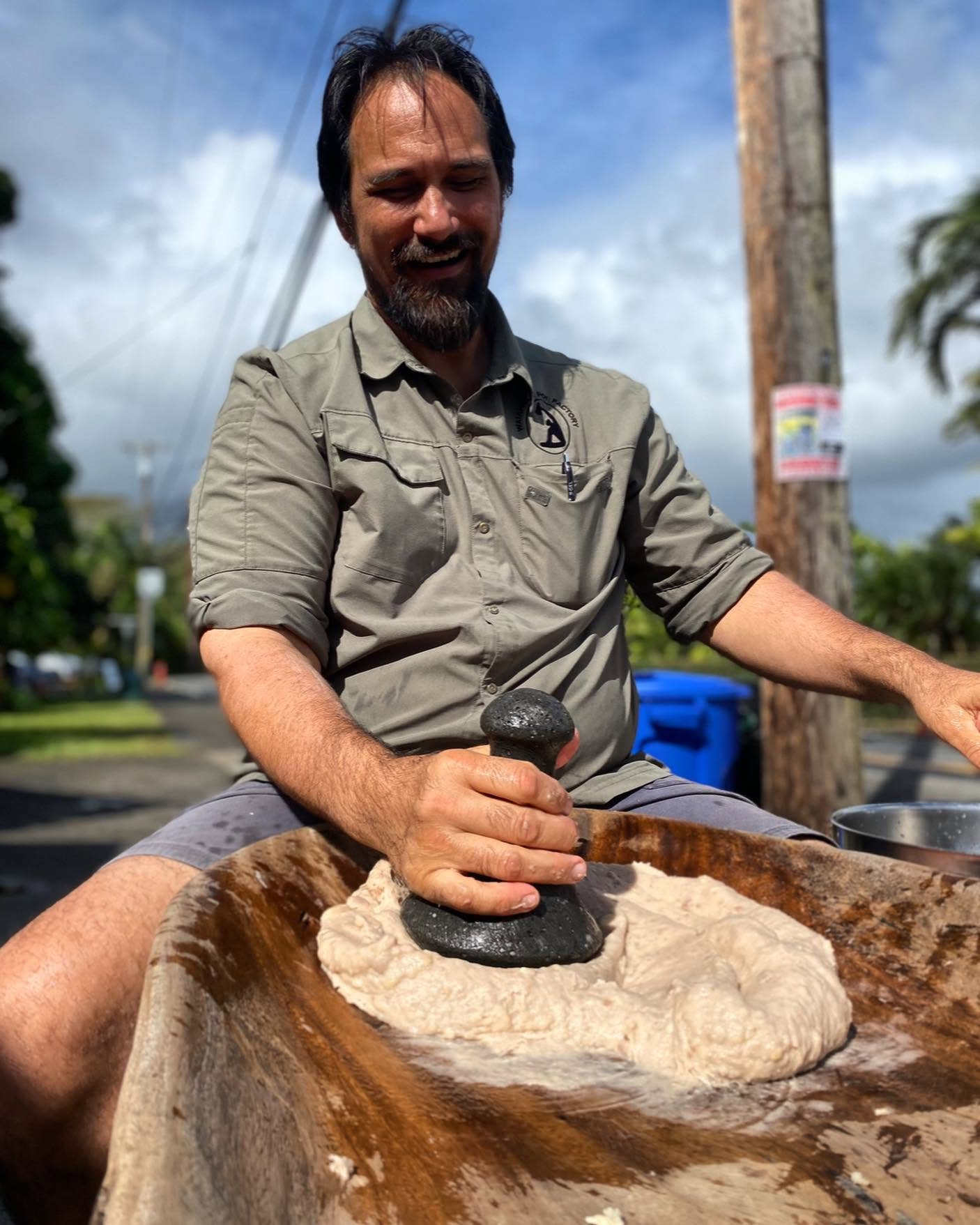
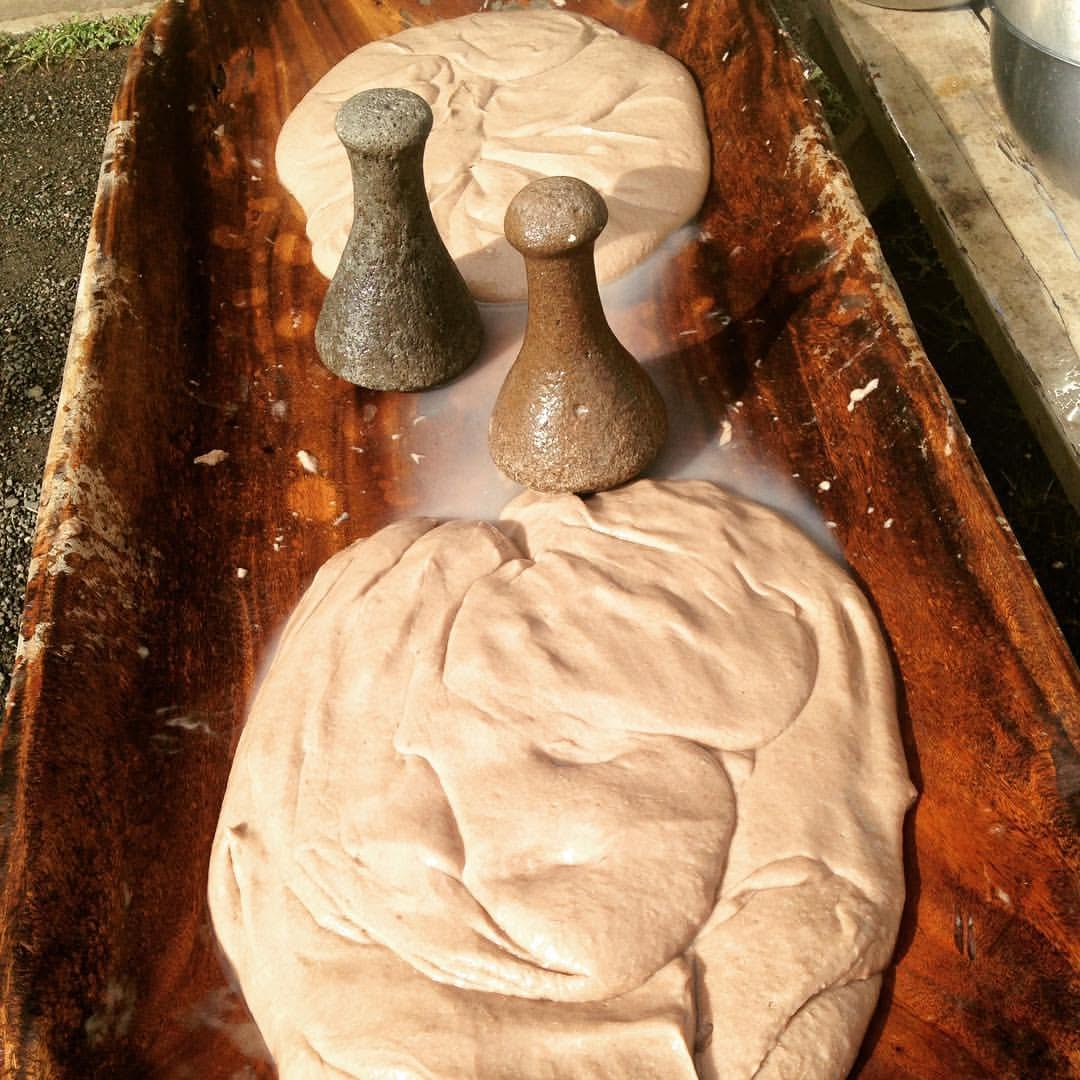
Once steamed and peeled, warm corm meets stone and wood: the papa kuʻi ʻai (carved wooden pounding board) and the pōhaku kuʻi poi (heavy basalt stone pounder). This step defines Hawaiian poi texture and flavor.
The Transformation to Paʻiʻai
Hand-pounding is a rhythmic, physical process. The practitioner dips hands and stone in water to stop sticking, crushing and folding the steamed kalo across the board. As the stone breaks down the cell walls, the starches bind together into a dense, smooth mass known as paʻiʻai.
Paʻiʻai is concentrated, pounded taro. It is firm, elastic, and full of natural flavor. Historically, travelers wrapped paʻiʻai in ti leaves for long journeys, as it kept well without spoiling.
How Hand-Pounding Shapes Consistency
What does real Hawaiian poi taste like? The answer depends on processing methods. Modern commercial producers often use mechanical steel grinders. While fast, high-speed blades tear starch molecules and mix in air, resulting in a thin, watery texture.
In contrast, the steady compression of a stone pōhaku preserves starch structure. This creates a dense poi consistency that clings naturally to a spoon or finger.
Decoding the Taste: What Does Real Hawaiian Poi Taste Like?
Many first-time visitors expect poi to taste sweet like dessert or heavy like gravy. Fresh poi has a clean, subtle flavor.
On the day it is made, fresh poi offers a gentle sweetness with earthy and floral notes. It works as a balancing element on the plate, pairing with rich, salty Hawaiian staples like lau lau, kalua pig, Lomi salmon, and fresh poke.
Natural Fermentation
Poi is an active, fermented food. Natural, beneficial microflora cause it to ferment over time, changing its character:
- Day 1 (Fresh): Sweet, mild, and earthy.
- Day 2 to 3 (Sour Poi): A clean, pleasant tartness develops, similar to unsweetened yogurt or sourdough starter.
- Day 4 and Beyond (Aged Poi): Tangy with a sharp acidity favored by traditional poi lovers.
Fermented poi remains good to eat. Its natural acidity makes it easy to digest, and the tart flavor cuts through fatty, rich meats.
Enjoy Authentic Hawaiian Food on Oʻahu
To taste true poi, look for kitchen teams that honor traditional preparation and source from local growers. Whether you are taking a scenic drive along the Windward coast or looking for a quick meal in Kāneʻohe, we invite you to table with us at either of our two locations.
Historic Waiahole Valley Location (Original)
If you are taking a scenic island road trip along the Windward coast, stop by our original historic Waiahole Valley location. Nestled beneath the Koʻolau Mountains, our 100 year old landmark serves fresh hand-pounded poi alongside traditional island favorites in a lush, historic setting.
Windward Mall Location (Kāneʻohe)
For everyday convenience, weeknight dinners, or quick lunch pickups in town, visit our Windward Mall location in Kāneʻohe. Located in the upper level food court, this spot offers extended daily hours and serves the exact same traditional recipes with maximum speed and accessibility.
Before heading out to either spot, feel free to view our complete traditional Hawaiian food menu to plan your meal.