
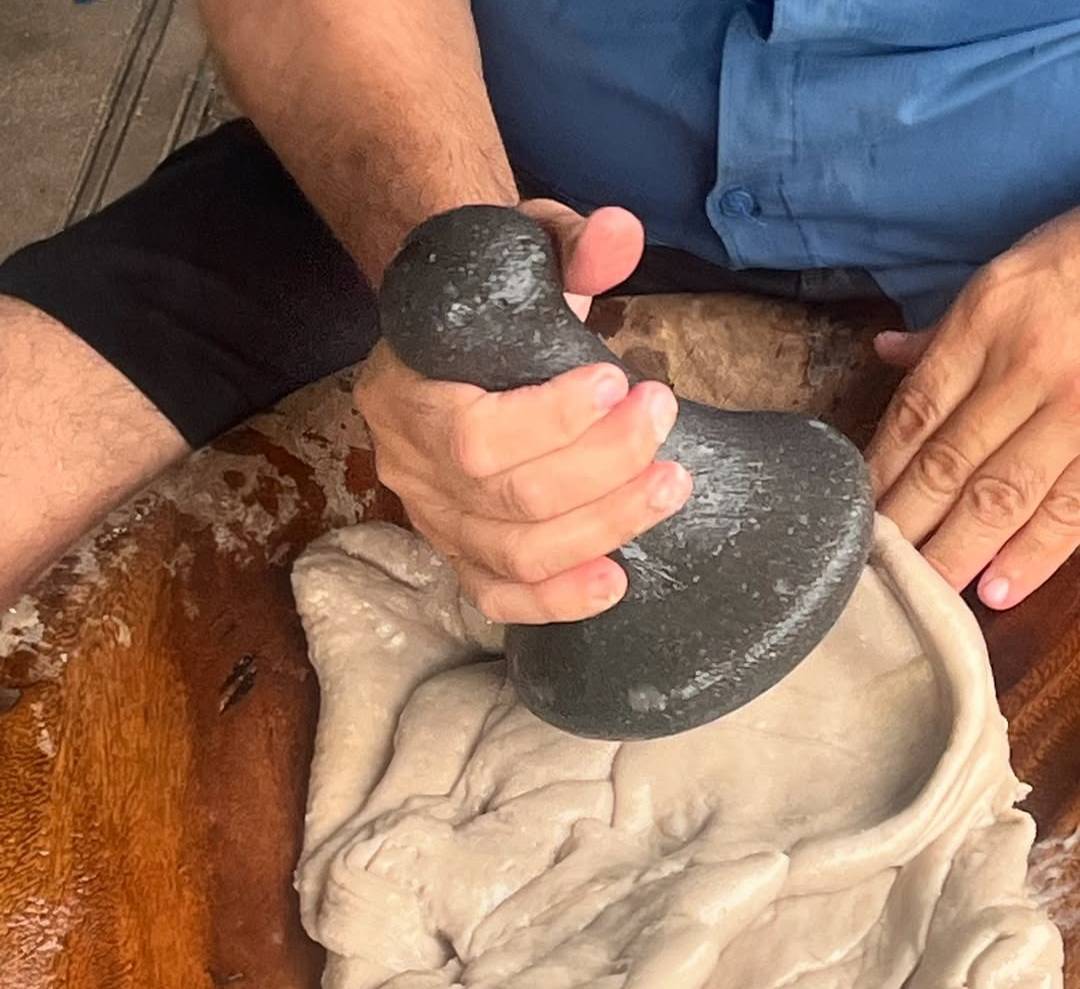
If you have heard about poi but aren’t entirely sure what to expect from your first taste, you are definitely not alone. This traditional, fermented taro paste is easily one of Hawaii’s most misunderstood foods—frequently dismissed by first-time visitors who make the mistake of eating it incorrectly, yet deeply revered by local residents as both sacred sustenance and a nutritional powerhouse. The distinct line between a disappointing first bite and a genuine, lifelong appreciation for the dish comes down to understanding exactly what poi is, how it is traditionally prepared by hand, and why it was never intended to be consumed entirely by itself.
To truly appreciate this staple of the Hawaiian plate lunch, one must look beyond the surface level of modern food trends. Whether you are stopping by a local counter-service window on your way up the Windward coast or exploring traditional menu options from the comfort of home, this comprehensive guide will give you the essential cultural context, culinary tips, and historical background you need before taking your very first taste.
What Is Poi? Understanding Hawaii's Ancient Superfood
At its most fundamental level, poi is a smooth, fermented taro root paste—the cooked and intricately pounded form of kalo, which is the Hawaiian word for the taro plant. This linguistic and structural distinction is incredibly important to understand: kalo refers specifically to the raw, living agricultural plant characterized by its large, heart-shaped green leaves growing in flooded wetland patches across the valleys, while poi is the final, carefully prepared food product that has sustained the people of Hawaii for over a thousand years.
In sacred Hawaiian tradition, poi is not viewed as a simple side dish or a generic carbohydrate; it is regarded as a living, breathing food. According to the foundational moʻolelo (oral history) of Hāloa, the very first taro plant grew from Hāloa-naka, the stillborn child of the gods Wākea and Hoʻohōkūlani. The second child born to the gods became the first human being, also named Hāloa. This makes kalo the literal elder brother of the Hawaiian people. This ancestral relationship explains why poi represents a profound, spiritual connection to both the physical land (ʻāina) and the ancestors. It also explains why arguing or raised voices were traditionally forbidden at the dinner table whenever an open bowl of poi was served.
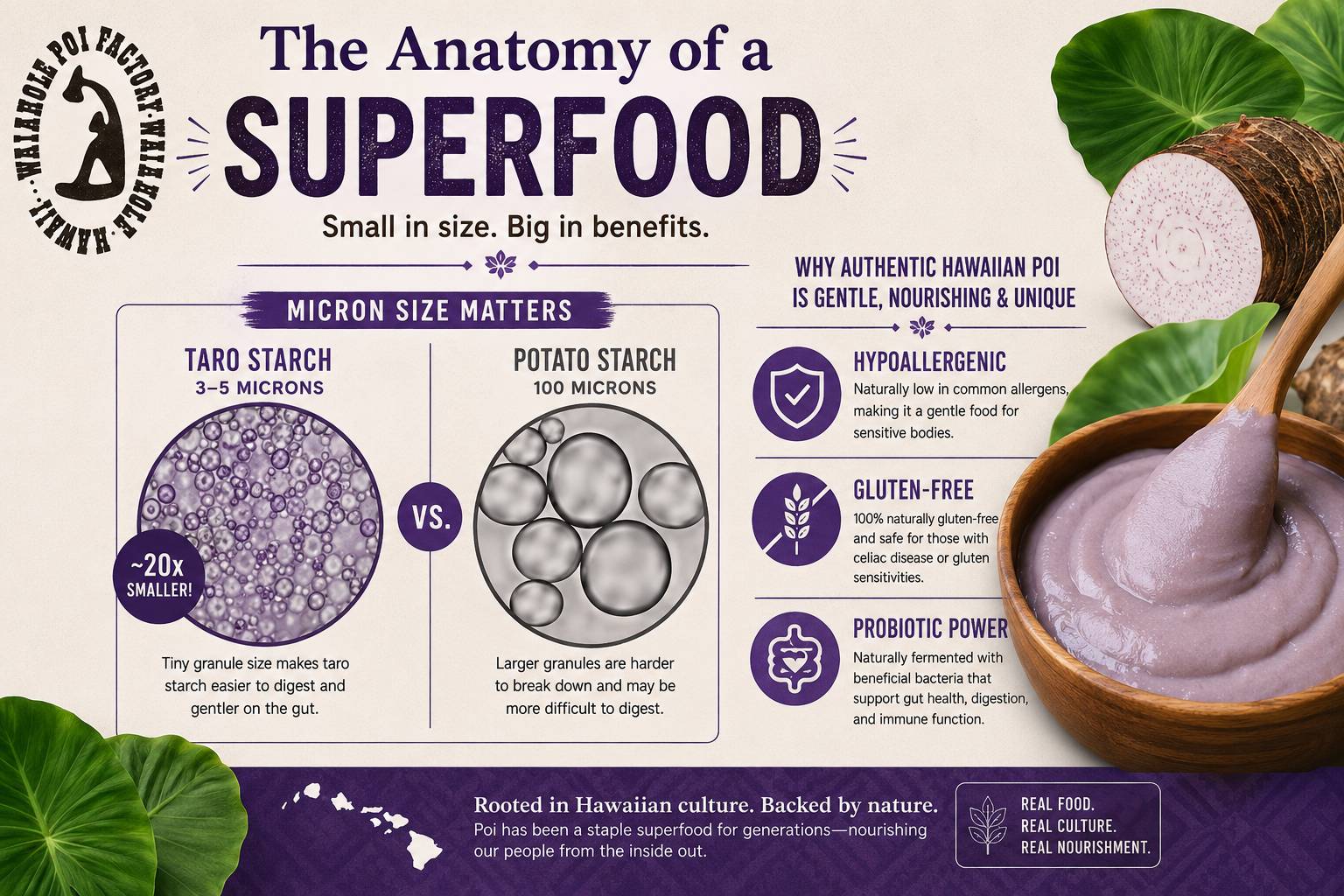
Beyond its deep cultural and spiritual cachet, the nutritional profile of this ancient staple completely backs up its status as the definitive "staff of life." Comprehensive agricultural research demonstrates that poi possesses incredibly small starch granules, measuring just 3 to 5 microns compared to the 15 to 100 microns found in standard potato or wheat starches. This unique cellular structure makes it one of the most easily digestible carbohydrate sources available on the planet, absorbing quickly into the body without stressing the digestive tract. It is completely hypoallergenic, dairy-free, and gluten-free, which is why pediatricians across the islands routinely recommend fresh poi as the perfect traditional first solid food for developing infants. Furthermore, the natural fermentation process creates beneficial lactic acid bacteria similar to high-quality yogurt, actively supporting gut health while functioning as a completely natural preservative.
How Traditional Poi Is Made: From Kalo to Bowl
The journey of authentic poi begins deep within the loʻi kalo—the flooded, mud-walled taro patches where the heavy corms are cultivated in cool, constantly flowing freshwater for 9 to 12 months before they are ready for harvest. The cultivation of kalo is itself a deeply spiritual practice. Local farmers must meticulously maintain the water flow through ancient irrigation systems, manually pull invasive weeds, and carefully tend to the ʻohana (the smaller offshoots that sprout directly from the parent corm), mirroring the way human families grow and branch out from their ancestral roots.
Once the harvest is complete, the whole taro corms are meticulously cleaned and steamed for 3 to 5 hours until the dense starch becomes completely soft, pliable, and gelatinized. It is at this exact stage of production where modern preparation methods sharply diverge. Traditional hand-pounding on a heavy wooden papa kuʻi ʻai (pounding board) utilizing a carved basalt pōhaku kuʻi ʻai (stone pounder) completely breaks down the tough, fibrous structures of the root, resulting in the flawlessly smooth, homogeneous texture that authentic poi is famous for. Conversely, modern mechanical processing—while significantly faster—shears the starch violently and leaves behind microscopic fibrous particles that create a distinctly grainier, chalkier consistency. You can instantly taste the difference on your tongue.
The Stages of Traditional Poi Consistency
Water is gradually, skillfully kneaded into the taro paste during the pounding process to achieve the maker's desired thickness. Freshly pounded poi typically registers a mild pH of 5.5 to 6.5, but because it is a living food, natural fermentation begins within 24 hours at room temperature. By day two or three, the beneficial lactic acid bacteria rapidly proliferate, dropping the pH down to a tangy 3.8 to 4.5. This drops the sweetness and develops the characteristic sour, robust notes that local residents heavily prefer. This fermentation is not spoilage; it is an intentional, health-boosting transformation identical to the creation of sourdough bread or kimchi, naturally extending the shelf life of the starch while unlocking complex flavor layers.
What Does Poi Taste Like and How to Eat It
Freshly made poi has a incredibly mild, slightly sweet, and profoundly earthy flavor profile—often described by culinary experts as a cross between unsweetened artisan yogurt and a silky, starchy pudding. The texture should feel completely velvety and uniform when properly crafted, containing absolutely no lumps, strings, or graininess. As the paste ferments over a span of one to three days, the natural sugars break down into lactic acid, creating sharp, tangy sourdough notes while the natural consistency thickens up. This fermented state is exactly when many local aficionados argue that the starch reaches its absolute peak flavor profile.
The primary reason first-time visitors often dislike their very first taste of poi is simply that they are eating it completely wrong. Poi was never engineered to be consumed as a standalone dish; it is a neutral, cooling starch base explicitly designed to balance out rich, heavy, and incredibly salty proteins. Before Western contact, native Hawaiians regularly consumed massive amounts of poi weekly, but it was always paired alongside savory staples like smoky kālua pork, refreshing lomi salmon, heavily salted butterfish, or pipikaula (dried beef). The smooth, bland sweetness of the taro instantly cuts through intense sodium levels, acting as a refreshing palate cleanser between bites.
To eat like a local, you should avoid taking a massive, isolated spoonful of plain poi. Instead, take a bite of your hot, salty protein first, and then immediately follow it with a scoop of cool poi using your fingers or a fork. The combination of the hot, savory meat and the cold, smooth starch is where the culinary magic actually happens. Judging plain poi by itself is the exact equivalent of judging dry, unsalted white rice without any meat or sauce—you are completely missing the entire structural context of the meal.
Where to Try Authentic Poi in Hawaii
When you are ready to experience poi for the very first time, the overall quality and preparation method of the product will entirely dictate your experience. You should exclusively seek out locally sourced, fresh poi that has either been created within the last 24 hours or has been intentionally fermented under controlled conditions—avoid mass-produced, chemically stabilized bag versions that sit on commercial shelves for weeks.
While many standard resort lūʻau operations serve highly diluted, machine-processed poi that has sat in refrigeration for too long, true food lovers should seek out authentic plate lunch spots and traditional family-owned venues. If you want to experience the absolute gold standard of traditional taro preparation, you need to go straight to a dedicated producer.
At the Waiahole Poi Factory, located at our historic storefront at 48-140 Kamehameha Hwy in Kaneohe, we are proud to be one of only 12 to 15 rare establishments in the entire state that still actively maintains the art of daily hand-pounded poi on-site. When you order from our kitchen window, you are not just purchasing a plate lunch; you are experiencing a living culinary tradition. Our family returned this historic 1905 building to its agricultural roots as a full-time restaurant in 2009, ensuring that our taro is sourced directly from local fields. Because our hand-pounded product is completely fresh and made in small batches daily, when it's gone for the day, it is officially gone!
Why the Hawaiian Poi Dog Went Extinct
The centrality of poi to the historical infrastructure of the islands is perfectly illustrated by the fascinating history of the native Hawaiian poi dog, known locally as the ʻīlio. This unique, pre-contact breed was physically characterized by its remarkably short legs, broad flat heads, and heavy, stout bodies—distinct physical traits that developed almost entirely as a result of a mandatory vegetarian diet consisting of surplus poi, mashed sweet potatoes, and local vegetables. Historical records preserved within the Bishop Museum describe these dogs as incredibly docile, slow-moving, and prone to extreme obesity due to their high-carbohydrate, low-protein communal diet.
Regrettably, the pure breed went functionally extinct by the turn of the 20th century. Following Western contact in the late 1780s, European breeds were rapidly introduced to the islands and quickly interbred with the native population. As the traditional Hawaiian lifestyle systematically declined and taro cultivation plummeted due to mass colonization and land shifts, local communities no longer possessed the massive agricultural surpluses of taro required to regularly feed domestic animals.
What this historical extinction reveals is absolutely striking: pre-contact Hawaii was so agriculturally prosperous and produced such an immense abundance of kalo that feeding domestic animals exclusively on premium poi was a routine, everyday occurrence. The ultimate disappearance of the poi dog tracks directly with the tragic disruption of traditional Hawaiian food systems. Today, the ʻīlio serves as a powerful, sobering symbol of exactly what is lost when native agricultural practices are allowed to collapse under external pressures.
This historical context is exactly why supporting local, Native Hawaiian-owned businesses like the Waiahole Poi Factory is about so much more than simply grabbing a delicious afternoon meal. When you choose to order our authentic, hand-pounded dishes, you are actively participating in the economic and physical preservation of an ancient agricultural art form. You are ensuring that the traditional knowledge of kalo processing survives for future generations to learn from, honor, and enjoy.
Experience True Island Tradition This Summer
Do not miss out on the rich history and deep cultural flavors that define our island home. Whether you are driving past the breathtaking Koʻolau mountains on a weekend summer road trip or looking to treat your family to a truly meaningful meal, make your next stop count. Come visit our kitchen window, unwrap a hot plate of traditional comfort food, and taste the difference that over a century of history makes.
Ready to try authentic hand-pounded poi? Explore Our Full Menu | Order Online - Waiahole Location | Order Online - Windward Mall Location