

If you've ordered a traditional Hawaiian plate, you may have noticed a small serving of chopped salmon, tomatoes, and onions alongside the main dish. That's Lomi Salmon, a familiar part of Hawaiian meals that brings a refreshing contrast to richer foods such as Kalua Pig and Laulau.
At Waiāhole Poi Factory, we include Lomi Salmon with our Single Plate, Combo Plate, and Kanaka Nui. Although it may look like a simple tomato salad, its combination of salt-cured salmon and vegetables gives it a distinctive place on the Hawaiian table.
Understanding what goes into Lomi Salmon and how it complements other dishes can help you appreciate why it's included with our plates.
What Is Lomi Salmon Made Of?
Lomi Salmon, also known as Lomi Lomi Salmon, is a Hawaiian side dish made with salt-cured salmon and chopped vegetables. It is generally served chilled and has a refreshing, savory flavor.
Our Waiāhole Poi Factory menu describes our Lomi Salmon as a combination of diced tomatoes, onion, green onion, and salt-cured salmon. These ingredients work together to create a side dish that contrasts with the warm, richer entrées on a traditional Hawaiian plate.
Salt-Cured Salmon
Salt-cured salmon gives the dish its savory character. Unlike freshly cooked fish, the salmon has been preserved with salt, which contributes to its distinctive flavor.
When mixed with tomatoes and onions, the salmon adds richness and seasoning without the need for a heavy dressing.
Tomatoes and Onions
Tomatoes contribute moisture and a mild acidity that balances the saltiness of the salmon. Their juicy texture is one reason Lomi Salmon tastes refreshing alongside cooked meat dishes.
Onions provide a sharper flavor, while green onions add another layer of onion flavor. Together, these ingredients give the dish its recognizable appearance and taste.
The combination is straightforward, but each ingredient has a purpose. Lomi Salmon doesn't need a thick sauce to complement the rest of a Hawaiian meal.
Why Is It Called Lomi Salmon?
The Hawaiian word lomi refers to rubbing or massaging. The name reflects the traditional method of combining the ingredients by gently working them together.
The dish is also commonly called Lomi Lomi Salmon, with the repeated word emphasizing the mixing action.
Although salmon is not native to Hawaiian waters, the dish became part of Hawaiian food traditions through cultural exchange after Western contact. Over time, salt-cured salmon combined with tomatoes and onions became a familiar accompaniment at Hawaiian gatherings.
Today, Lomi Salmon is commonly served alongside dishes such as Kalua Pig, Laulau, and Poi. Its presence on a Hawaiian plate reflects how food traditions can incorporate introduced ingredients while becoming part of a community's shared meals.
Why Is Lomi Salmon Served With Hawaiian Food?
Traditional Hawaiian plates often include several foods with different textures and flavors. Some dishes are rich and savory, while others provide a milder or more refreshing contrast.
Lomi Salmon plays an important supporting role because its salted fish, tomatoes, and onions complement the flavors of the main entrées.
For example, our Kalua Pig is slow-cooked and smoked for twelve hours before being shredded and seasoned with Hawaiian sea salt. Laulau, another traditional dish, contains pork and a touch of butterfish wrapped and steamed in taro leaves.
Both are substantial dishes with rich flavors. A small serving of Lomi Salmon introduces the freshness of tomatoes and the sharper taste of onions between bites.
This contrast is part of what makes a Hawaiian plate enjoyable as a complete meal rather than simply a collection of separate foods.
How Does Lomi Salmon Pair With Poi?
Poi is made from cooked kalo, or taro, that is milled or pounded and mixed with water until it reaches a smooth consistency. Its relatively mild flavor makes it a natural companion to more strongly seasoned foods.
Lomi Salmon provides a different kind of contrast. While poi offers a smooth, starchy element, Lomi Salmon adds saltiness and the moisture of chopped tomatoes.
When eating a Hawaiian plate, you can enjoy a little poi with your main entrée and take bites of Lomi Salmon between them. There's no requirement to combine everything into one spoonful. Each part of the plate contributes something different to the meal.
At our restaurant, the poi served with a regular plate should not be confused with our specialty hand-pounded poi. We make hand-pounded poi using the traditional board and stone at our Waiāhole Valley location on Wednesdays and Sundays, subject to availability.
If you're interested in trying that specialty, call (808) 239-2222 to confirm the pounding schedule before visiting.
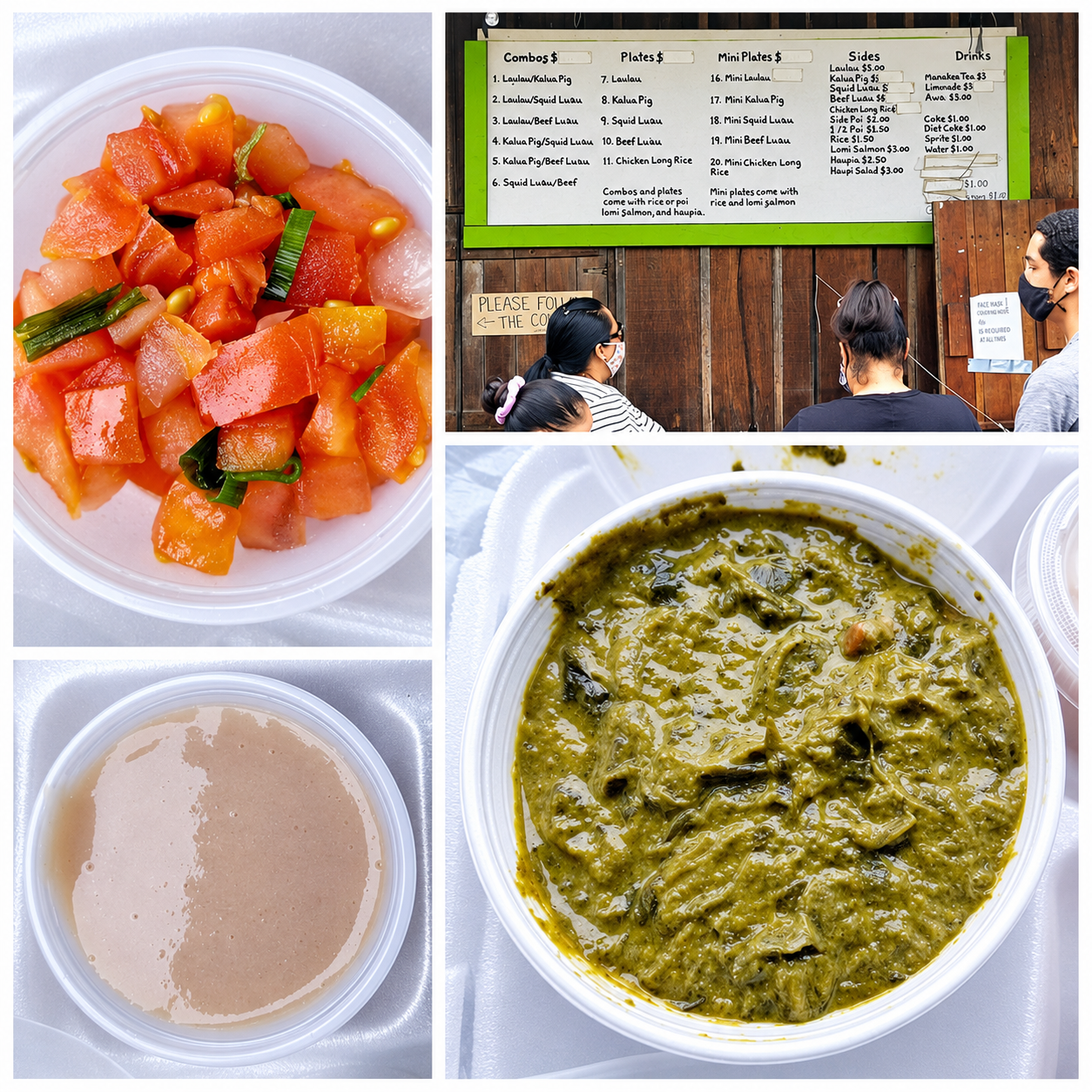
Which Waiāhole Poi Factory Plates Include Lomi Salmon?
Lomi Salmon is included with several of our main plate options. Whether you prefer one entrée or want to sample multiple Hawaiian dishes, you can enjoy it as part of the meal.
Our current Hawaiian food menu offers the following choices:
The Single Plate is a straightforward choice if you already know which entrée you want. The Combo Plate allows you to choose two different entrées, while Kanaka Nui brings together several dishes on one plate.
Lomi Salmon is included with these plates, so you don't need to order it separately to experience how it complements the meal.
You can also order Lomi Salmon as an individual side from our published menu. This can be useful when you're sharing food or simply want an additional serving.
Menu selection and availability may vary by location.
Lomi Salmon and Other Hawaiian Plate Sides
Lomi Salmon is not the same as Poi or Haupia, even though all three can accompany a traditional Hawaiian plate.
Each has a different role in the meal.
Lomi Salmon is a savory side made with salt-cured salmon, tomatoes, and onions. It contributes a refreshing contrast to cooked entrées.
Poi is a smooth taro-based starch that complements the stronger flavors of foods such as Kalua Pig and Laulau.
Haupia is a coconut dessert with a consistency similar to custard. On our Single Plate, Combo Plate, and Kanaka Nui, it provides a sweet finish to the meal.
Understanding these differences makes it easier to appreciate the complete plate. Rather than treating the accompaniments as optional extras, consider how they contribute to the balance of the food.
Can You Order Lomi Salmon for a Family Gathering?
Lomi Salmon is also part of our Hawaiian food catering menu, where it is available in different pan sizes.
If you're arranging food for a family gathering, graduation, or company lunch, you can include Lomi Salmon alongside traditional entrées such as Kalua Pig or Laulau.
Our catering menu provides estimated serving quantities for different pan sizes, making it easier to plan the amount needed for your guests. Lomi Salmon can help bring variety to a meal centered on richer dishes.
We cater small company lunches for approximately 10 people as well as family gatherings with more than 100 guests. Catering orders require at least 48 hours' notice, or one week for parties of more than 40 people.
For quantities and ordering arrangements, visit our catering page or call (808) 239-2222.
Order Hawaiian Food Online From Our Two Locations
Ready to enjoy Lomi Salmon with your next Hawaiian plate? We offer online ordering for pickup at both our Waiāhole Valley restaurant and Windward Mall location in Kāneʻohe.
Choose the location most convenient for you and explore the available menu before placing your order.
Waiāhole Valley Location
48-140 Kamehameha Highway, Kāneʻohe, HI 96744
Order Online – Waiāhole Valley
Windward Mall Location
46-056 Kamehameha Highway, Kāneʻohe, HI 96744
Try Lomi Salmon With Your Next Hawaiian Plate
Lomi Salmon may be a small part of a Hawaiian plate, but it has a clear purpose. Its combination of salt-cured salmon, tomatoes, and onions provides a refreshing contrast to the rich flavors of traditional Hawaiian entrées.
At Waiāhole Poi Factory, we serve it with our Single Plate, Combo Plate, and Kanaka Nui, making it easy to enjoy alongside the dishes you choose.
If you're planning your next meal, explore our full Hawaiian food menu or visit our official website to select a location and access online pickup ordering.
We look forward to sharing our Hawaiian food traditions with you. Mahalo for your support.