
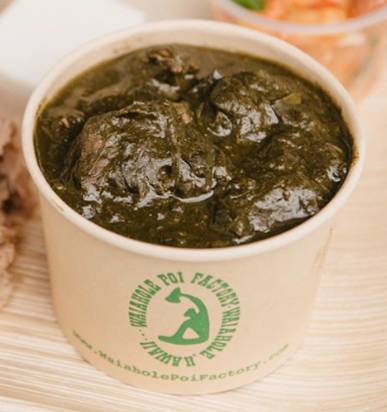
Traditional Hawaiian lūʻau dishes get their distinctive flavor and texture from the leaves of the kalo (taro) plant. But what happens when you want to make something similar and cannot find taro leaves?
Spinach offers a practical alternative. It softens quickly, works well with coconut milk, and provides a mild leafy flavor. The result is a spinach-based stew inspired by Hawaiian lūʻau, rather than a replacement for the traditional dish.
At Waiāhole Poi Factory, we prepare Beef Lu'au and Squid Lu'au using taro leaves. We'll explain what makes those dishes different, how a spinach adaptation can be prepared, and what to expect when you taste traditional lūʻau.
Can You Use Spinach Instead of Taro Leaves in Luau Stew?
Yes. Spinach can be used to make a lūʻau-inspired stew, although it does not reproduce the exact flavor or consistency of cooked taro leaves.
Lūʻau leaves come from the kalo plant, which has a significant place in Hawaiian food and culture. The underground portion of kalo is used to make poi, while its leaves are used in preparations such as Beef Lu'au, Squid Lu'au, and Laulau.
Spinach has a milder flavor and requires much less cooking time. This makes it convenient when preparing a leafy stew with meat or coconut milk, but the finished dish will have a different character.
Spinach vs. Taro Leaves: What Changes?
One important difference is food safety. Raw or inadequately cooked taro leaves contain calcium oxalate crystals that can irritate the mouth and throat. They must be properly cooked before eating.
The University of Hawaiʻi provides additional information on preparing taro leaves for Hawaiian dishes.
Spinach also contains naturally occurring oxalates, but it is commonly eaten raw or cooked. It should not be treated as nutritionally identical to taro leaves.
Why Traditional Hawaiian Luau Uses Taro Leaves
A spinach version can be enjoyable, but understanding the traditional ingredient helps explain why the two dishes are different.
Kalo is used in several forms throughout Hawaiian cuisine. Its underground portion becomes poi, while the leaves are cooked in dishes such as lūʻau and laulau.
At our restaurant, we use taro leaves in two different preparations.
Our Beef Lu'au
Our Beef Lu'au is a savory stew made with braised beef chuck, sautéed onions, ginger, and taro leaves that are slow-cooked until tender.
The beef provides a hearty texture, while the cooked leaves become part of the stew.
Unlike the spinach recipe above, our published Beef Lu'au preparation does not list coconut milk as an ingredient.
Our Squid Lu'au
Our Squid Lu'au combines tender, thinly sliced octopus with slowly cooked taro leaves, coconut milk, and Hawaiian sea salt.
The coconut milk produces a rich, creamy consistency that distinguishes it from our beef preparation.
Although both dishes use lūʻau leaves, their proteins and accompanying ingredients create different eating experiences.
You can explore both dishes on our Hawaiian food menu.
Luau Stew vs. Laulau: What Is the Difference?
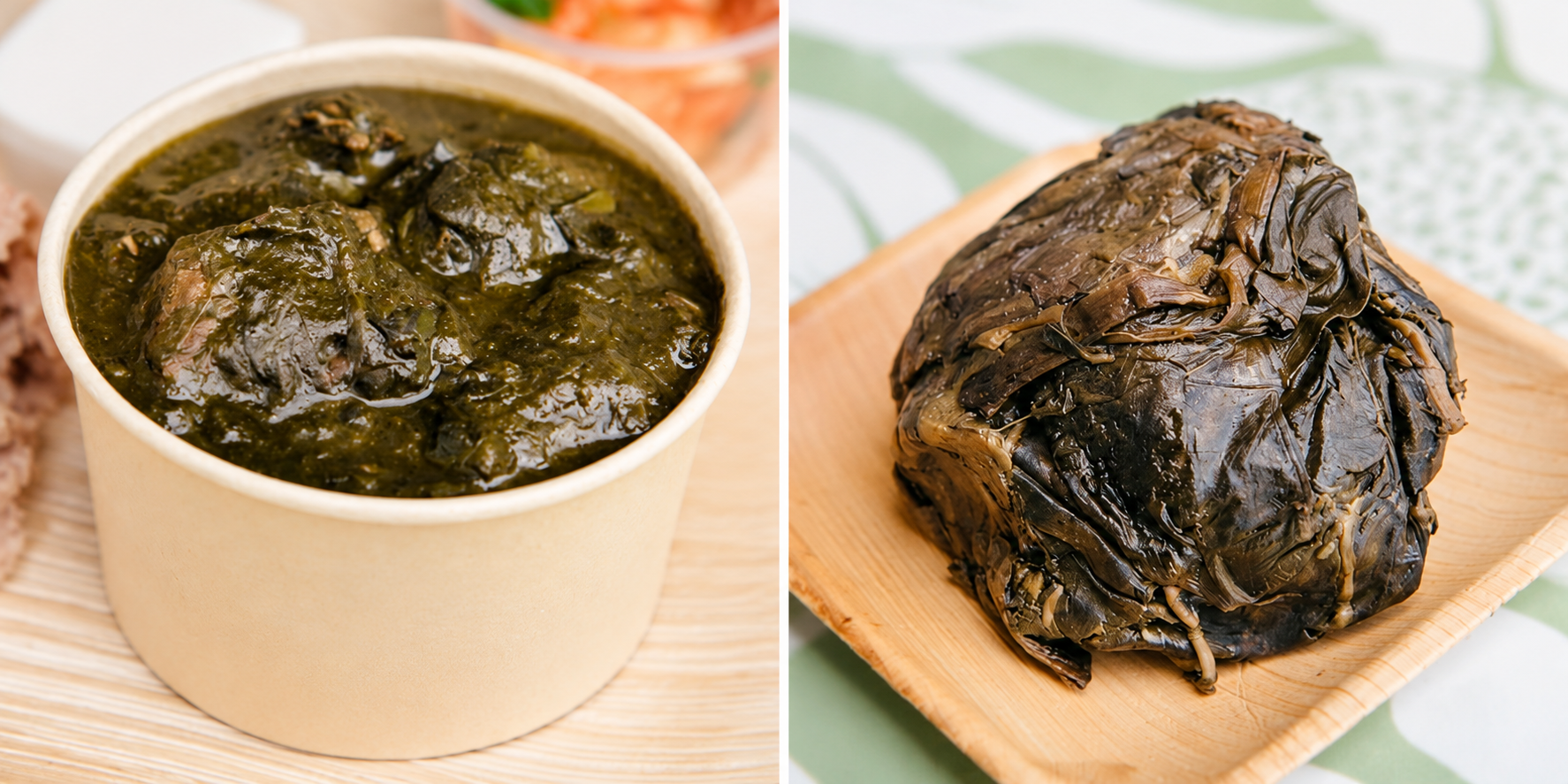
Lūʻau stew and laulau both use taro leaves, but their preparations are different.
In lūʻau stew, the cooked leaves are combined with ingredients such as beef or octopus to form a moist, spoonable dish.
Laulau, on the other hand, is prepared as a wrapped bundle that is steamed.
Our Laulau features pork and a touch of butterfish wrapped in taro leaves. The leaves soften during cooking and are eaten along with the filling.
The distinction matters when considering substitutions. Spinach can soften into a stew, but it is too delicate to replace taro leaves directly in a traditional laulau bundle.
For more information about how the leaves function in that dish, read our guide to taro leaves for laulau.
What to Serve with Spinach Luau Stew
A spinach-based stew can be served with simple accompaniments that allow its flavor to remain the focus.
Steamed white rice provides a neutral base for the coconut milk sauce. Poi offers a different pairing, with its smooth texture and distinctive taro flavor.
For those unfamiliar with poi, it is made from the cooked underground portion of the kalo plant, which is milled or pounded and mixed with water.
At our restaurant, poi is available as a side and as an alternative to rice on our Single Plate, Combo Plate, and Kanaka Nui.
Our rice bowls, however, come with rice rather than poi.
If you'd like to explore how traditional Hawaiian foods are combined into a meal, our menu explains the plate options and their accompanying sides.
Enjoy Traditional Luau Dishes at Waiāhole Poi Factory
Making a spinach-based adaptation offers one way to explore the ingredients and textures associated with Hawaiian lūʻau. But spinach and taro leaves are not interchangeable when it comes to the traditional character of the dish.
At Waiāhole Poi Factory, our connection to kalo goes back to the historic poi factory building in Waiāhole Valley. Our family took over the space in 1971 and began operating the full-time Hawaiian food restaurant in 2009.
Today, we continue serving traditional Hawaiian food, including Beef Lu'au and Squid Lu'au.
You can enjoy either dish as a side or choose it as the entrée in a Single Plate. Our Combo Plate lets you choose two entrées, so you can pair one of our lūʻau dishes with another Hawaiian favorite.
Our Kanaka Nui plate also includes your choice of Beef Lu'au or Squid Lu'au, along with Laulau, Kalua Pig, Chicken Long Rice, rice or poi, Lomi Salmon, and Haupia.
Visit Us on Windward Oʻahu
Historic Waiāhole Valley Location
48-140 Kamehameha Hwy, Kāneʻohe, HI 96744
Wednesday through Monday, 10:00 AM to 6:00 PM. Closed Tuesdays.
Windward Mall Food Court
46-056 Kamehameha Hwy, Kāneʻohe, HI 96744
Monday through Thursday, 10:00 AM to 8:00 PM; Friday and Saturday, 10:00 AM to 9:00 PM; Sunday, 10:00 AM to 6:00 PM.
Whether you're already familiar with traditional Hawaiian lūʻau or trying it for the first time, we'd be happy to share our food with you.
Explore our full menu or visit our online ordering page to choose a location and plan your pickup.